
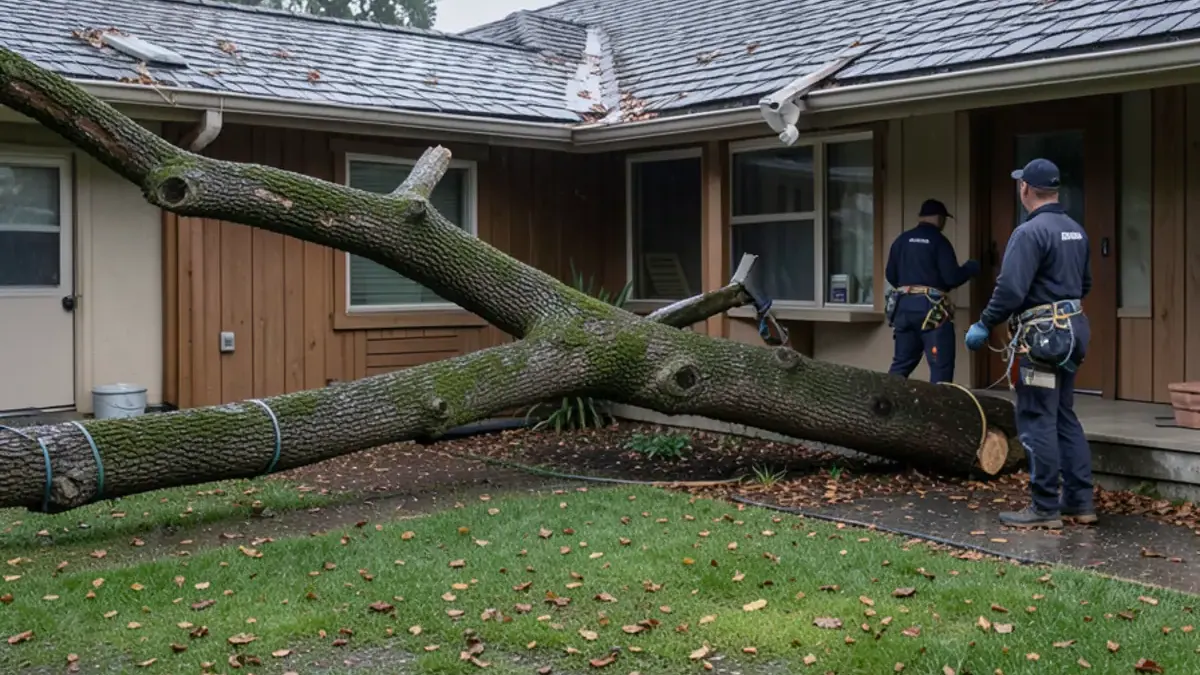
Tree fell on roof: what to do in the first few minutes
- Get people and pets out of the rooms under the impact. Ceilings can drop hours after the tree lands, especially once rain soaks the drywall.
- Look for wires before you look at the roof. If a power line is touching the tree, the gutter or the ground, stay well back and call 911 and PG&E.
- Shut off power to the damaged area at the panel if water is reaching light fixtures and you can reach the panel safely.
- Do not climb onto the roof or the tree. Trunks shift as branches are cut or as the wind changes, and damaged rafters may not hold a person.
- Take photos and video from a safe distance before anything moves: the tree on the roof, the inside rooms, and any damaged cars, fences or gutters.
Tree on the house and rain on the way? Call (725) 745-8803 and we'll tell you when a crew can get there to assess and cover the roof.
Call (725) 745-8803Who do you call, and in what order?
Several trades are involved, and calling them in the wrong order wastes time. A roofer cannot cover a hole that still has a trunk in it.
| Order | Who | What they handle |
|---|---|---|
| 1 | 911 and PG&E (if wires are down) | Life safety, de-energizing lines |
| 2 | Tree service or arborist | Removing the tree from the roof in controlled sections |
| 3 | Roofer | Temporary cover, damage assessment, photos and written estimate |
| 4 | Your insurance company | Opening the claim and scheduling an adjuster |
| 5 | Other trades as needed | Electrician, drywall, engineer for broken framing |
In practice, steps 3 and 4 often happen the same day. Report the claim as early as you can, and tell the insurer a temporary cover is going on to prevent further damage.
Why the tree has to come off before the roof is repaired
A fallen trunk acts as a lever on rafters and ceiling joists. Cutting it the wrong way can let it roll or drop deeper into the house. Tree crews remove it in pieces, often with a crane on large oaks, redwoods and eucalyptus, which are common on older South Bay lots.
- Ask the tree crew to avoid dragging limbs across undamaged roof sections.
- Have them leave cut sections off the driveway if a roofing crew needs access for materials.
- Keep a few photos of the stump and the break point; adjusters sometimes ask whether the tree was healthy.
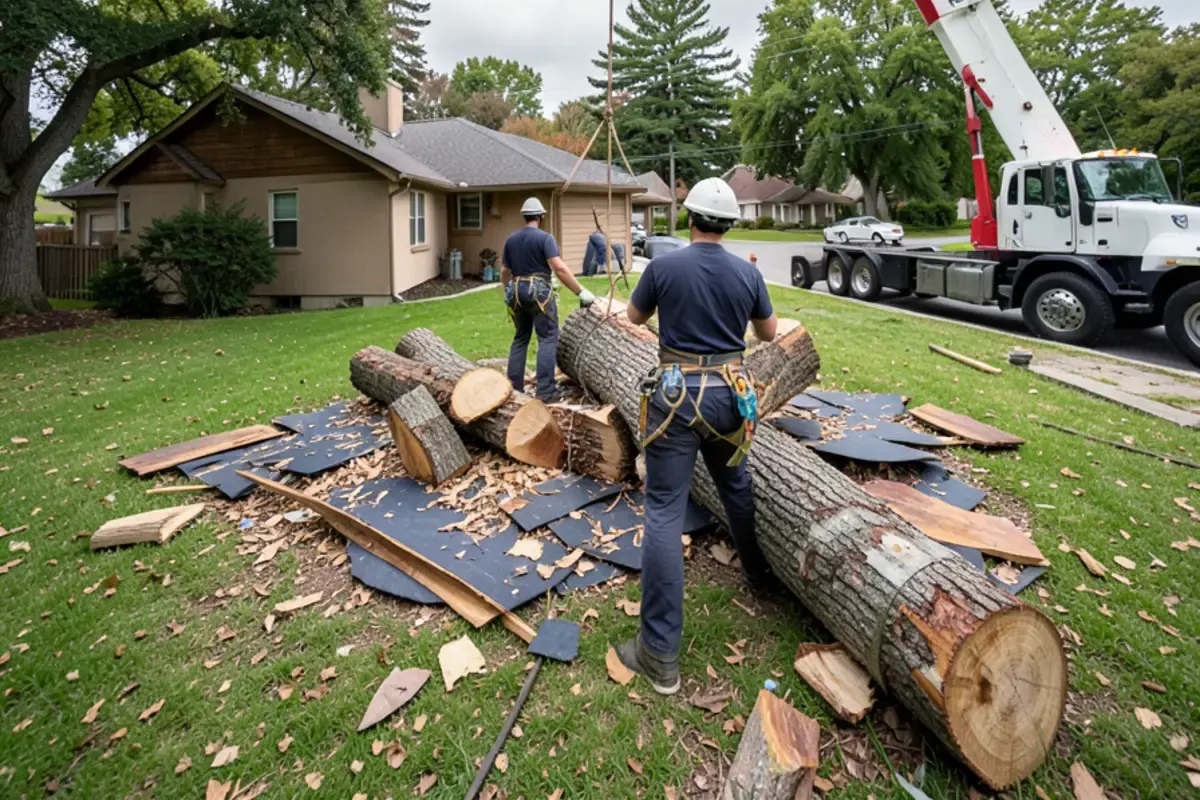
Covering the opening once the trunk is gone
A tarp alone cannot span a hole where the deck and rafters are broken; it sags, fills with rain and tears. When the strike went through the framing, the cover goes on in layers:
- Clear broken material from the opening so splintered boards do not puncture what goes over them.
- Brace or bridge the gap. Temporary 2x lumber laid across sound rafters on either side carries the load where the broken ones cannot.
- Sheath over the hole with plywood or OSB fastened to the sound framing, so the cover has a solid surface under it.
- Tarp over the patch and the ridge, with battens, so water sheds past the repaired area.
- Photograph each stage for the claim file before the next layer hides it.
For smaller punctures where the framing held, emergency roof tarping over the damaged shingles is usually enough to keep the house dry until the permanent repair.
How is fallen tree damage documented for an insurance claim?
Coverage depends on your policy. Many homeowners policies address damage to the house from a falling tree, and some include a set amount for tree removal, but limits and exclusions vary. Read your declarations page and ask the insurer directly.
Good documentation makes that conversation easier. Our roof insurance claim help focuses on clear photos of the impact zone, the attic framing, the decking and the interior, plus a written, itemized estimate the adjuster can compare line by line. We help you document the damage and work with your insurer; the coverage decision is theirs.
Records worth keeping from day one
- The tree service invoice, with a line for removal from the roof
- The temporary cover invoice and before-and-after photos of the cover
- Receipts for hotel stays or meals if part of the home is unlivable; many policies include loss-of-use coverage, but check its terms
- A list of damaged belongings with photos, kept before anything is thrown away
- Names and dates for every call with the insurer and adjuster
Standard policy forms often treat tree debris removal as a separate, limited additional coverage, apart from the damage to the house itself. That is one more reason to read the policy rather than assume the whole cleanup is included.
Repair the struck section or replace the roof?
The answer depends on what broke, how old the rest of the roof is and whether the materials still match. These are the cases we see most often after storm-season tree strikes.
| What the strike damaged | Usual plan | Why |
|---|---|---|
| Shingles and gutters only, deck intact | Sectional repair | Framing is sound; matching new shingles to the slope is the main task |
| Deck punctured, rafters intact | Replace decking and roofing in the area | The deck has to be solid before new underlayment goes on |
| Split or broken rafters or ceiling joists | Framing repair, often with an engineer and a permit | Load paths have to be restored before roofing |
| Strike on a roof already near the end of its life | Discuss replacing the full slope or roof | A patch on a worn roof may not outlast the next storm season |
| Clay or concrete tile | Salvage sound tile and source matching pieces | Discontinued profiles can be hard to match |
From our roof visits: damage hides past the impact point
The hole is the obvious part. The less obvious part is everything a falling tree pushes on as it lands. Shingles several feet from the strike can be cracked or unsealed, ridge caps get knocked loose, and gutters pull away from the fascia under a branch's weight.
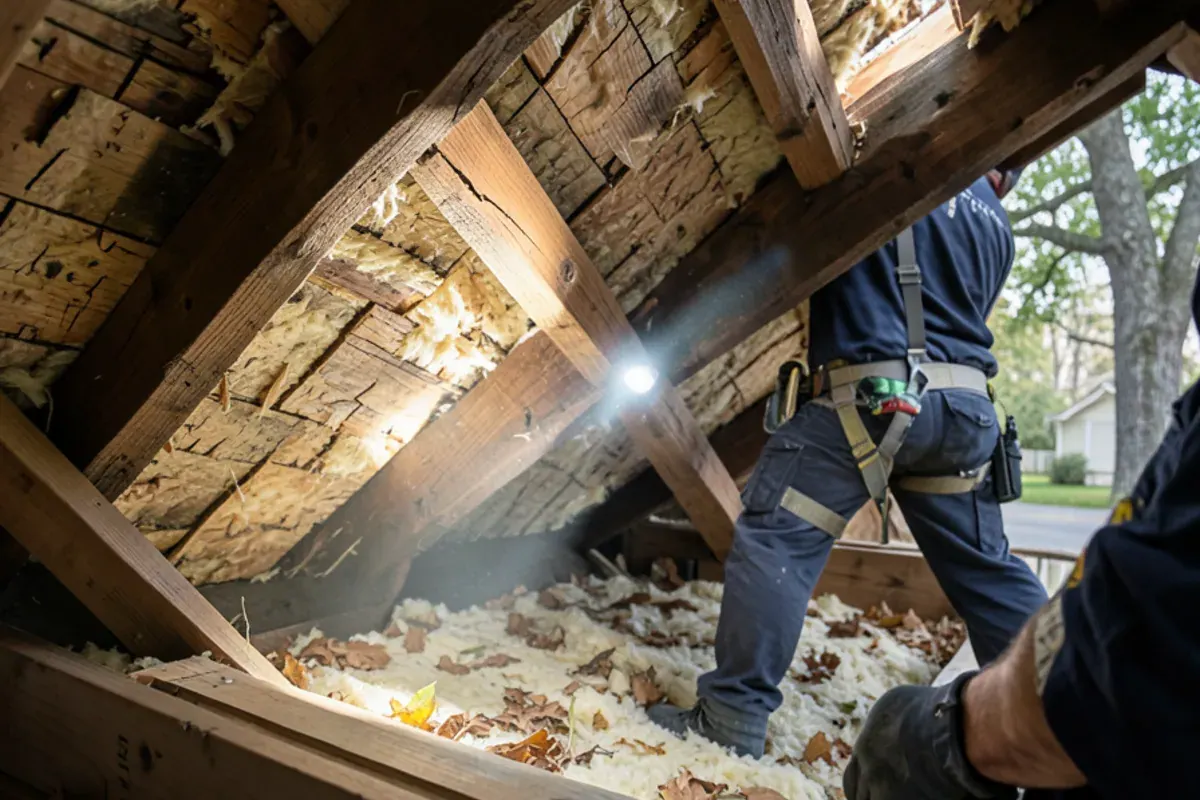
Inside the attic, rafters may be split along their length without any visible sag from below. Nails can be pushed partly out of the decking across a wide area. That is why an assessment for fallen tree roof damage should include the attic and the full slope, not just the opening.
The trade-offs we explain before anyone signs
A sectional repair is cheaper and faster, but new shingles rarely match a slope that has weathered for fifteen years; the color difference fades somewhat over time but may not disappear. Sistering a new rafter alongside a cracked one keeps the original framing in place and can be quicker than full replacement, though some cracks call for removing the member entirely, and that call belongs to an engineer when the damage is significant. Waiting for the adjuster before doing anything is a mistake if rain is coming; protecting the house first, with photos, is what the policy usually asks of you anyway.
Permits, protected trees and structural repairs
Replacing broken rafters or large areas of decking is structural work, and it typically needs a building permit. Who issues it depends on the address: cities issue their own, while homes in unincorporated pockets go through the County Planning and Development Department. Our page on roofing across Santa Clara County explains which office covers which areas.
Several cities regulate removal of protected or heritage trees, and hillside communities such as Saratoga have tree rules of their own. Emergency removal of a tree that has already fallen is usually handled differently from a planned removal, but check with your city's planning or arborist office before cutting any standing trees that were damaged in the storm.
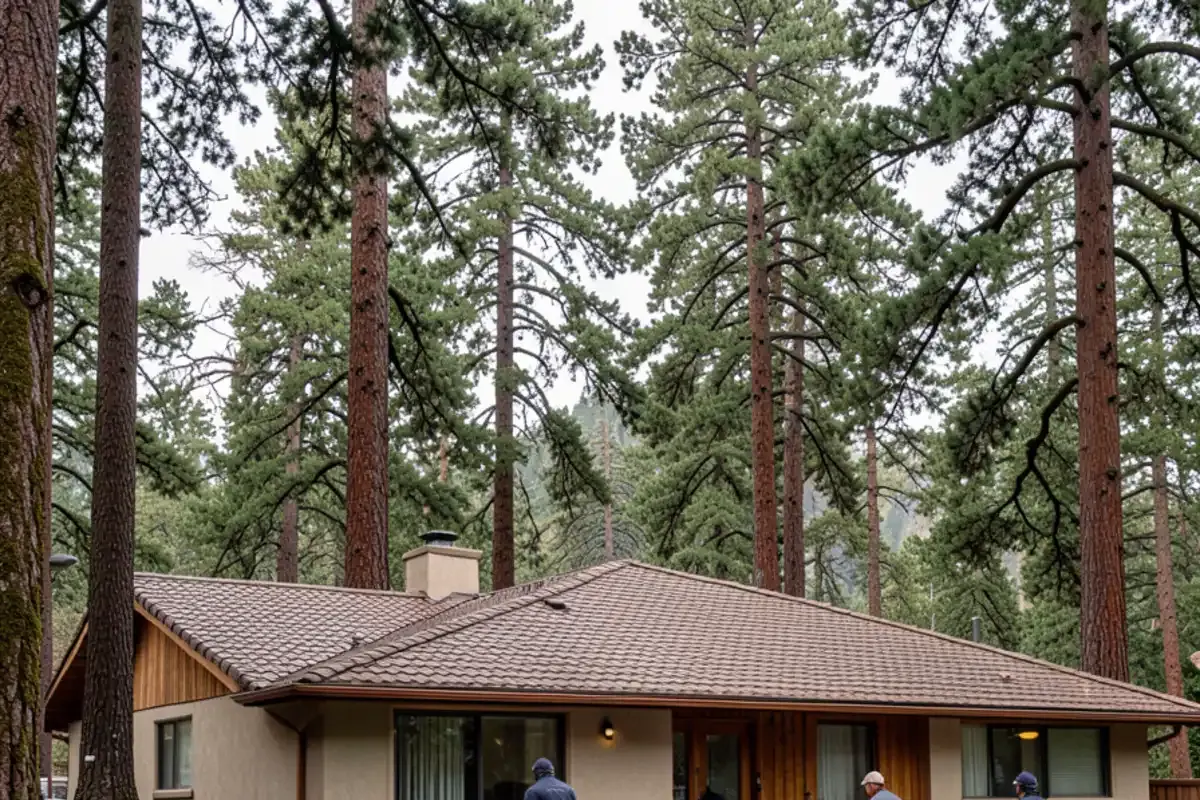
Once the roof is closed up, walk the yard with a fresh eye. Trees that lost their neighbor in the storm, limbs hanging over the ridge or roots lifted on one side are worth showing to an arborist before the next wet season.
Tree off the roof and ready for a cover or an estimate? Phone (725) 745-8803 to book the damage assessment.
Call (725) 745-8803