
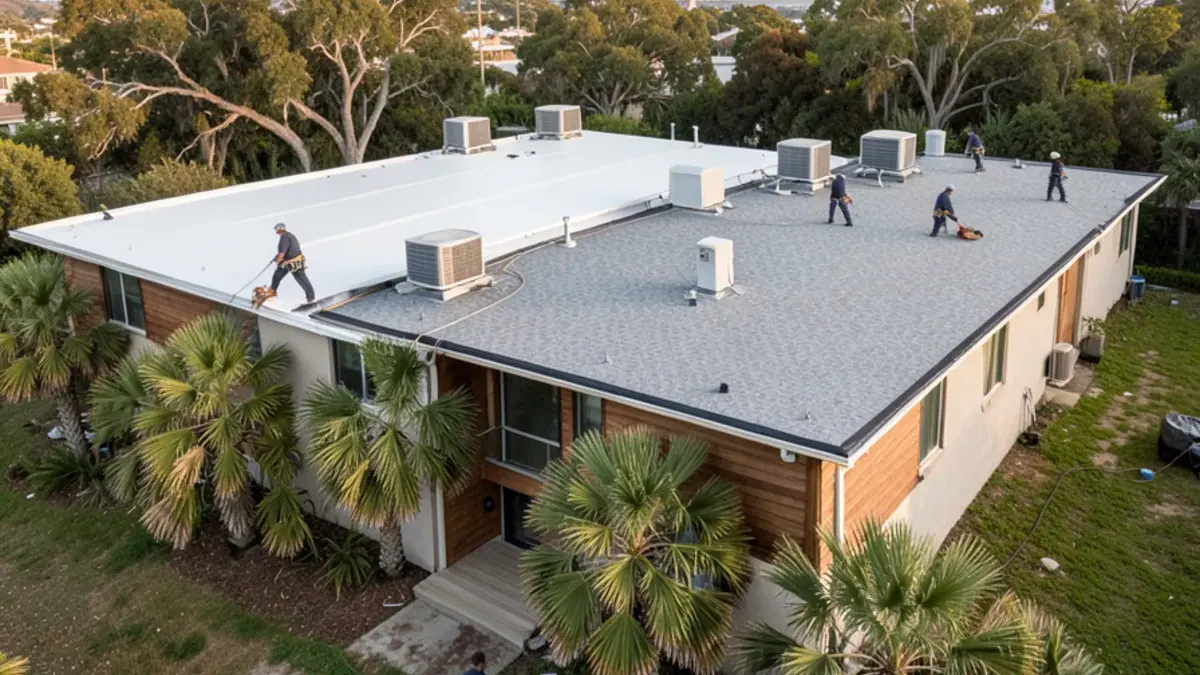
How do the three flat roof membranes compare?
TPO and PVC are single-ply membranes: one reinforced sheet, usually white, fastened or adhered to insulation and heat-welded at the seams. Modified bitumen is asphalt blended with rubber or plastic modifiers, laid in two or more plies and joined by torch, hot air or self-adhering laps. Torch-down is the version most homeowners have heard of.
| Factor | TPO | PVC | Modified bitumen |
|---|---|---|---|
| Build-up | Single reinforced sheet | Single reinforced sheet | Base sheet plus granulated cap sheet |
| Seams | Hot-air welded | Hot-air welded | Torched, heat-welded or self-adhered laps |
| Relative installed cost | Lower | Higher than TPO | Similar range to TPO; varies by number of plies |
| Foot traffic | Fair; add walkway pads | Fair; add walkway pads | Good; thick cap sheet resists scuffs |
| Grease and chemicals | Moderate resistance | Strong resistance | Poor near grease exhaust |
| Reflectivity | White standard | White standard | Cool-rated caps or a reflective coating needed |
| Repairs | Weld a patch to clean membrane | Weld a patch; welds well even when aged | Torch or cold-applied patch; forgiving |
| Fire safety during install | No open flame | No open flame | Torch-applied needs fire watch; self-adhered avoids flame |
Standards and sheet thickness to ask about
Each membrane has an ASTM material specification: ASTM D6878 for TPO sheet, ASTM D4434 for PVC sheet, and a family of standards for modified bitumen, including D6164 for polyester-reinforced SBS and D6222 for polyester-reinforced APP. Single-ply sheets come in nominal thicknesses such as 45, 60 and 80 mil. The extra thickness sits over the reinforcing scrim, which is the layer weathering exposes first, so a thicker sheet buys time on a sunny roof. Ask for the standard and thickness on the estimate.
SBS or APP: two kinds of modified bitumen
APP (atactic polypropylene) modified bitumen is a stiffer, plastic-modified sheet that is almost always torch-applied. SBS (styrene-butadiene-styrene) is rubber-modified, stays more flexible, and can be torched, set in hot asphalt or cold adhesive, or bought as a self-adhered sheet. When a roof sits close to wood siding, eaves or vents, the self-adhered SBS route keeps the toughness of a two-ply system without an open flame.
Need help choosing a membrane for your flat roof? Phone (725) 745-8803 for a roof walk and a written comparison.
Call (725) 745-8803Why seams decide how a flat roof ages
Field membrane rarely fails first. Seams, edges and penetrations do. A properly hot-air welded TPO or PVC seam fuses the two sheets into one piece, and an installer can probe every seam with a hook to find gaps before leaving. The quality depends on welder temperature, speed and clean, dry surfaces, which is why the same membrane performs very differently from one crew to the next.
Modified bitumen laps are wider and more forgiving of small flaws, but a torched lap that was underheated can open years later. With any of the three, ask how seams are tested and how flashings at walls and curbs are built. Those answers say more about the finished roof than the brand name on the roll.
What repairs look like years later
Repairability matters as much as day-one performance. Weathered TPO has to be scrubbed and prepped, and a test weld checked, before a patch will fuse; some older sheets resist welding and need a primer-based detail instead. PVC generally welds well after cleaning, but it must be kept apart from asphalt materials, so tie-ins to old torch-down need a separation layer. Modified bitumen is the most forgiving to patch: a torched or cold-applied piece of cap sheet bonds to aged material with simple prep.
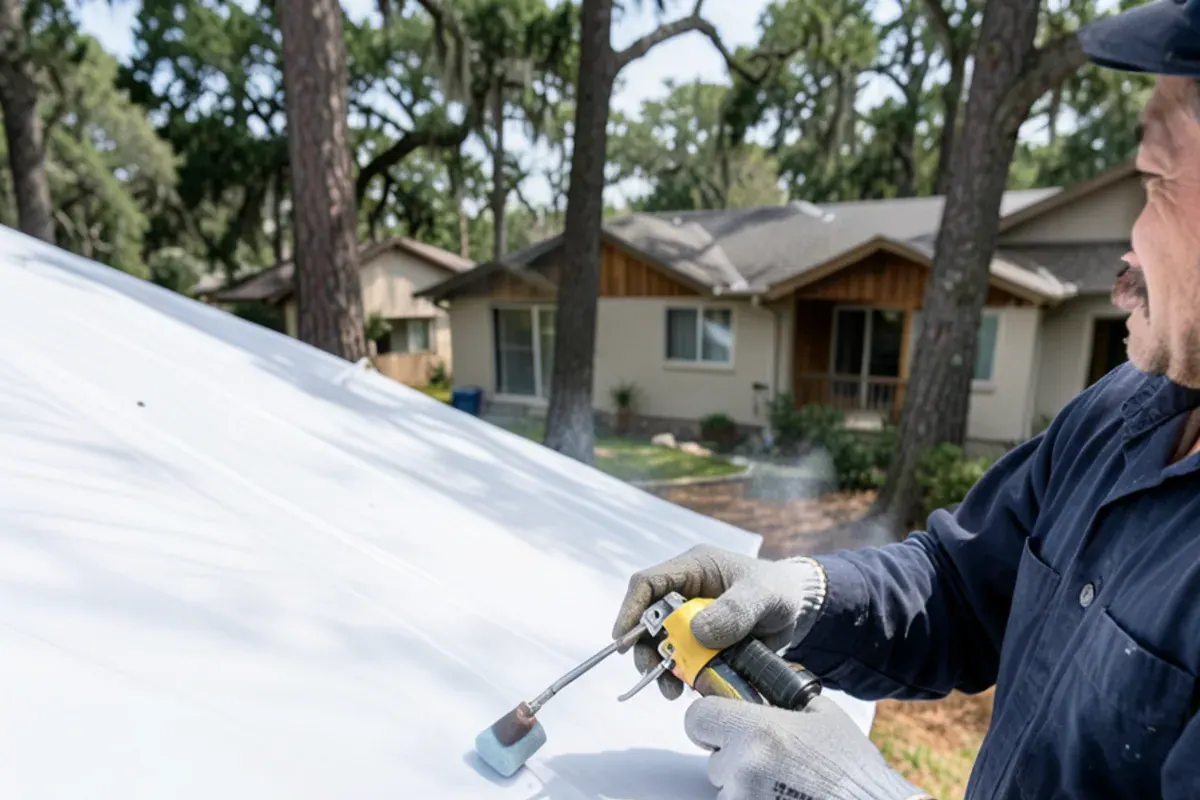
Foot traffic, roof decks and rooftop solar
If people walk on the roof regularly, to service HVAC units, reach a solar array or use a roof deck, the membrane takes a beating. Modified bitumen's granulated cap holds up well to scuffs. TPO and PVC need walkway pads along service paths and protective layers under deck pedestals.
For solar, all three can carry arrays. Ballasted racks sit on protection pads without penetrations; attached racks need flashed mounts. The bigger rule is timing: a new membrane under a new array avoids paying to remove and reinstall panels a few years later. Our TPO and PVC roofing page explains attachment methods for both single-ply options.
What does Title 24 ask of a flat reroof?
The cool-roof section of Title 24, Part 6 applies to some reroofs, and low-slope roofs are the most common trigger. Whether your project qualifies depends on climate zone, how much of the roof you replace and the building type. Campbell sits in Climate Zone 4.
White TPO and PVC usually meet reflectance targets on their own when the product is rated by the Cool Roof Rating Council. Modified bitumen typically needs a cool-rated cap sheet or a reflective coating. Insulation levels can come into play too when the roof is opened. Get the building department's answer before the scope is final.
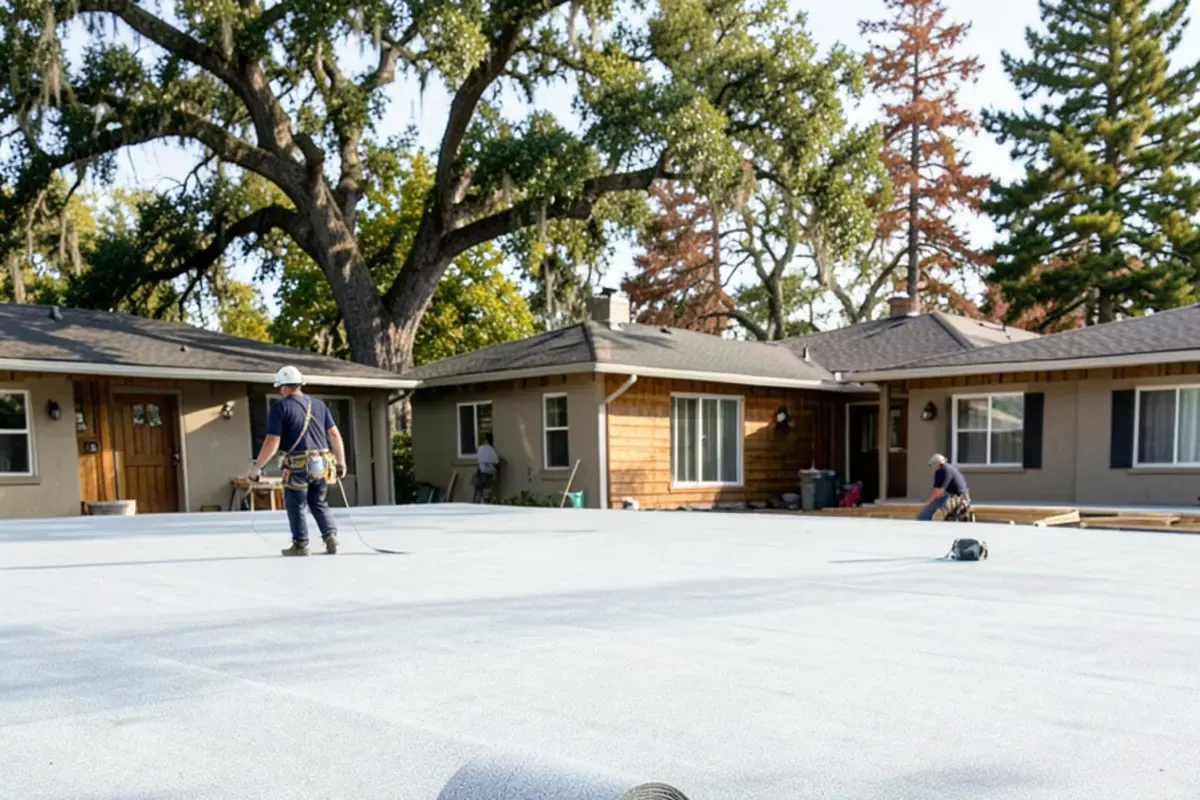
Choosing a membrane in four questions
- Is there grease or chemical exhaust on the roof? Restaurant hoods and some lab or shop vents point to PVC.
- Will people walk on it often, or will it carry a deck? Modified bitumen or a thicker single-ply with walkway protection.
- Is the roof simple, open and mainly about budget? TPO is often the efficient choice.
- Is open flame a concern near wood framing, vents or a tight courtyard? Choose a welded single-ply or self-adhered modified bitumen instead of torch-down.
Eichler roofs and other mid-century flat roofs add one more factor: exposed beams and thin roof assemblies leave little room for insulation, so tapered insulation for drainage has to be planned carefully. Our flat roof replacement page covers tear-off, tapering and edge details. Office parks and small commercial buildings in Santa Clara lean toward TPO for large open roofs and PVC where kitchens share the roof.
From our roof visits: details that outlast the membrane choice
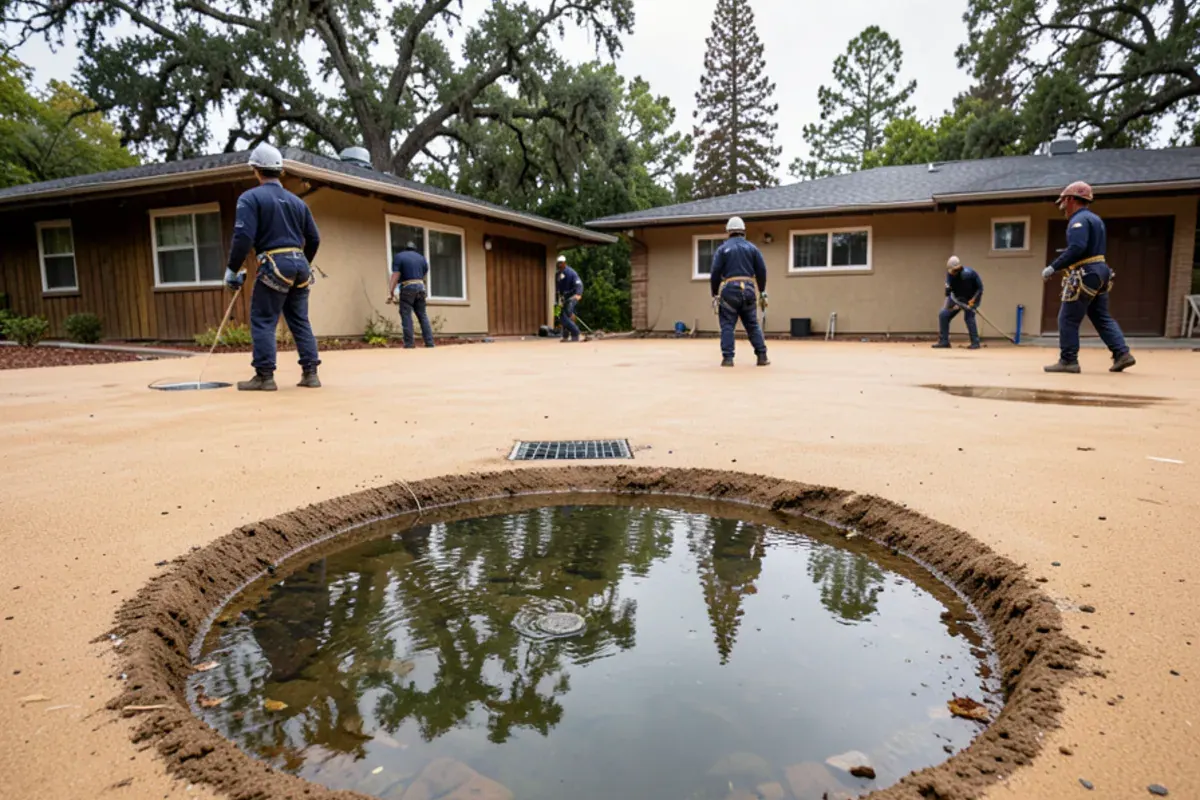
Whatever membrane goes down, ponding is the enemy. Water that sits for days after rain finds every flaw and, on modified bitumen, wears the granules off. Low spots near drains, sagging decks and drains set higher than the surrounding roof are common on older flat roofs and should be corrected during replacement, not after.
Edge metal and scuppers are the other repeat issue. Old gravel stops and rusted scuppers often get reused to save money and become the first leaks on a new roof. Penetrations from abandoned equipment should be removed and the deck patched rather than flashed around. Flat roofs on homes and garages around Campbell follow the same rules on a smaller scale.
Every membrane has an honest downside. TPO is the budget-friendly single-ply, but quality varies by formulation and repairs on old sheet take more prep. PVC handles grease and welds reliably, at a higher cost and with care needed at transitions. Modified bitumen shrugs off foot traffic and patches easily, yet it is heavier, dark unless it has a cool-rated cap or coating, and torch-applied versions bring fire risk to the job. We put those trade-offs next to your roof's traffic, drainage and equipment before recommending one.
The short version for your flat roof
If you remember one thing, make it this: the membrane choice follows the roof's use, and the installation details decide how long it lasts.
- Open roof, little traffic, budget matters: white TPO with welded, probed seams.
- Kitchen exhaust, oils or chemicals: PVC, separated from any asphalt roofing it meets.
- Roof deck, frequent service or tight spaces near wood: modified bitumen, self-adhered where flame is a concern.
- Ponding, rusted edge metal or abandoned curbs: fix these in the scope whichever membrane wins.
Comparing membranes for a home, garage or small commercial roof? Ask Xylo Fix Roofers for a roof walk and a written side-by-side.
Call (725) 745-8803